
The World Won't Change Until You Do
There’s only one way to reclaim the script that’s been running you.
Turn on the news (or scroll on your phone for five seconds) and you’ll see it: outrage, blame, division, chaos. The world right now feels like one giant group project where everyone is yelling at each other and nobody is actually reading the assignment.
It’s tempting — almost effortless — to get pulled into the drama. To react. To point fingers. To fight for our side.
But there’s a harder truth I keep bumping into: the world doesn’t change just because I want them to change. It won’t change because I win an argument or prove a point on social media. It won’t change because I hold tighter to my judgments of who’s right and who’s wrong.
The world changes when I do.
That’s not a slogan. It’s a daily practice.
Drama is automatic
In a recent post for my Emotional Wellbeing Series, I wrote about mindlessness and the way our brains put life on autopilot in order to (very efficiently) conserve energy. Albeit unconscious, and mostly harmless, the habits it creates are sneaky, and can wreak havoc without us even realizing it.
You know those moments when you swear you’re cool as a cucumber — and then someone says something and suddenly you’re snapping, shutting down, or giving a masterclass in sarcasm? Yeah, in those moments, it does feel like you don’t have much control over your reactions. That’s because some habits turned into reactivity.
If automaticity is the quiet hum of patterned behaviors — the coffee made the same way every morning, the scroll through your phone without thinking —, reactivity is its louder sibling.
Reactivity is like mindlessness on steroids. It’s autopilot too, just faster and messier. It’s what happens when our survival programming slams the gas pedal.
Someone cuts you off in traffic? Boom — anger.
A family member dismisses you? Snap — defensiveness.
You scroll past another headline that feels like proof the world is doomed? There goes your nervous system, firing like it’s the end times.
Your chest tightens, your tone sharpens, your hands get sweaty and the next thing you know you’re saying or doing something you didn’t plan. Something that doesn’t even sound like you.
That’s because it isn’t you. These aren’t conscious choices. They’re scripts written long ago, fueled by your nervous system shortcuts.
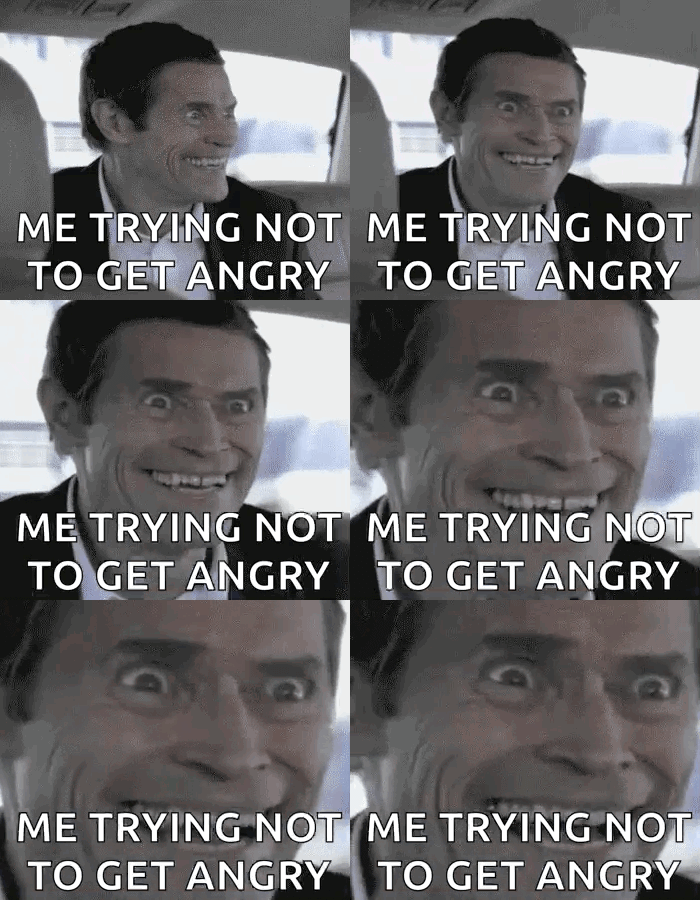
I notice them most often when I feel threatened, dismissed or unheard. My body reacts like it’s DEFCON 1. My throat fills up with words that tumble out faster than I can catch them, and before I know it, I’ve said something that makes me think, “Cool, now I sound like my mother.”
My nervous system doesn’t stop to ask, “Is this really dangerous?” It just reacts as if it already knows.
Maybe it’s a stress response story learned in childhood, maybe it was reinforced in difficult relationships, inherited from the culture around me. And I get it, it’s my nervous system’s way of keeping me safe. Except, that safety often comes at the expense of showing up as my authentic self.
Reactivity is less logical and more full system takeover. I don’t get to choose. The reaction chooses me. Anger flares, or withdrawal shuts me down. Either way, the deeper truth — the one we’re all purposed to express — gets buried.
I know that when I live reactively, the world has me. I’m no longer leading and creating; I’m a vassal to an old programming. The difference is that here, the only way to get back in control is to pause.
One tiny breath.
A millisecond of noticing.
That’s it.
For me, the pause feels like this:
I notice my body tensing up.
I catch the heat rising, like a kettle about to spill over.
Instead of snapping back, I say (sometimes only internally): “Breathe.”
Then I take that deep breath. And another one — a deeper one. I feel my feet and I observe my internal dialogue. I notice what’s really being triggered — the familiar thoughts about how I’m misunderstood or not good enough.
This happens in a split second. But that is where choice lives. Not perfection. Not suppression. Just choice. In the crossroads between the familiar reaction and the intentional response.
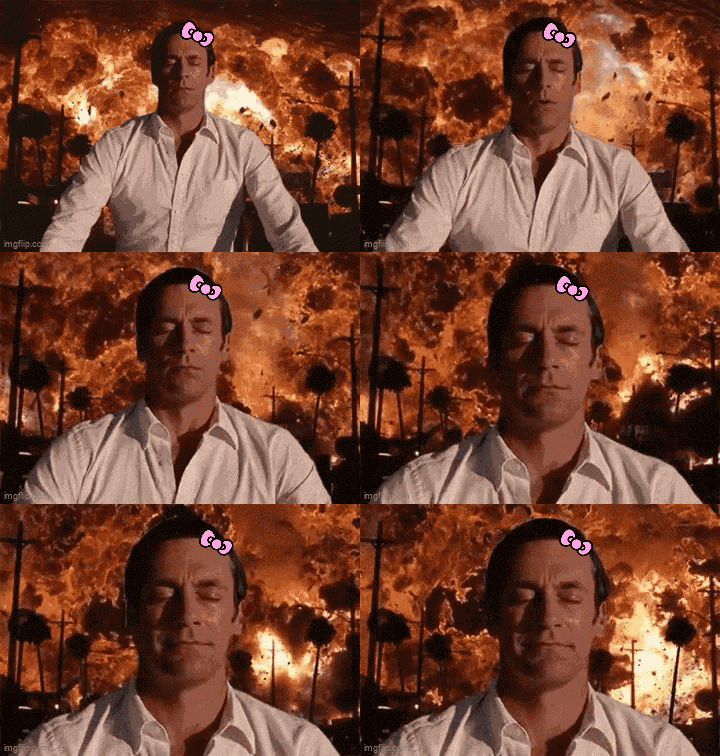
And wow, is it hard. When you’re mid-reaction, pausing feels like trying to stop a train with your pinky finger. And if you manage to slow it down, soon you’re hit with the next layer of defense: judgment in the form of shame.
Lately, I’ve been noticing how judgment seems to be the world’s favorite pastime. And it can feel righteous, protective, even satisfying.
When I judge, I’m usually doing one of two things: either I’m protecting myself from discomfort — after all, if I label them as wrong, I don’t have to feel my own fear or grief — or trying to prove my worth through comparison, because at least I’m not as bad as them.
The problem? Judgment keeps me looping the same autopilot patterns of reactivity. It doesn’t change anything out there. It just deepens the grooves of separation in here.
And if the world is caught in judgment — endless wars over who’s right, who’s wrong, who’s in and who’s out — then the only way to shift it is for me to notice when I’m playing the same game.
I’m learning that the most radical thing I can do in a reactive moment is also the simplest: to pause.
The pause is the revolution.
It sounds too small to matter. But that single breath — the one that stops me from firing off the email, slamming the door, or throwing another log on the drama fire — is revolutionary.
It interrupts automaticity. It puts me back in choice.
That’s where response lives, and where change begins.
That’s when the world starts to shift because I stop reenacting the same scripts that created it.
When I’m able to meet reactivity with curiosity instead of shame, I can learn what is trying to teach me. Underneath the flare is always a need:
Anger / Irritation
Trigger: Being dismissed, disrespected, interrupted, ignored.
Underlying need: Respect, recognition, fairness.Withdrawal / Shutdown
Trigger: Feeling unsafe, overwhelmed, criticized, or emotionally flooded.
Underlying need: Safety, space, self-regulation.Defensiveness
Trigger: Being blamed, misunderstood, or accused.
Underlying need: Understanding, validation, to be seen.Anxiety / Worry
Trigger: Uncertainty, unpredictability, loss of control.
Underlying need: Reassurance, stability, clarity.Jealousy / Envy
Trigger: Seeing others receive love, attention, or success we crave.
Underlying need: Belonging, self-worth, acknowledgment.Guilt / Shame
Trigger: Criticism, rejection, failure to meet expectations (our own or others’).
Underlying need: Acceptance, forgiveness, unconditional love.Sadness / Grief
Trigger: Loss, separation, disconnection.
Underlying need: Connection, comfort, companionship.Frustration / Feeling Stuck
Trigger: Blocked goals, repeated obstacles, lack of progress.
Underlying need: Autonomy, agency, movement, possibility.
And the more I recognize those patterns in myself, the less hooked I get by the patterns in the world.
So, what does this have to do with the bigger picture — the wars, the politics, the endless cycles of division? Everything.
Because the world is just a collection of individuals playing out their automatic scripts. When I break the pattern in me, I create the possibility for something new in us.
It may look small — pausing before a sharp word, choosing curiosity over judgment, breathing instead of spiraling into outrage — but multiplied by millions, those tiny revolutions are what shifts collective reality.
The quiet revolution starts inside.
It starts with self-leadership.
With choosing response over reactivity.
That doesn’t look glamorous. It’s not going viral on social media. And is not going to make you rich quick either.
Self-leadership is often soft, silent and invisible. But make no mistake. It is mighty. Because when you lead yourself, you stop contributing to the cycle of unconscious drama.
You become a conscious co-creator.
Now, let’s be clear: this isn’t about perfection. If my experiences are teaching anything is this: I still react. I still judge. Sometimes I catch myself only hours later, replaying the scene in the shower, wishing I had paused sooner. That’s part of the practice.
Leading yourself first isn’t about never slipping. It’s about noticing faster, softening sooner, and choosing differently more often.
It’s about remembering that you’re not your reaction. You’re the one who notices the reaction arising. And that noticing — quick, human, imperfect — is enough to shift the course of the next moment.
Try it for Yourself
Next time you feel your inner kettle about to whistle, here’s a practice you can play with:
Notice drama. In yourself, in the world, wherever it shows up.
Pause. Even one breath is enough to shift gears.
Ask: What’s my script here? What’s the story I’m telling myself to justify feeling the way I’m feeling? What am I trying to protect?
Choose: Is there a response I can make that aligns with who I want to show up as, rather than reacting out of a familiar pattern?
Channel your inner Neo and break out of your Matrix. I doubt you’ll be able to dodge bullets, but you’ll have other choices. Sometimes the choice is to speak with honesty. Sometimes it’s to stay quiet. Sometimes it’s to walk away. All are valid — as long as they come from presence, not autopilot.
The world won’t change until you do. Not because you’re responsible for fixing everything, but because your self-leadership is the ripple that makes collective change possible.
Automaticity keeps us asleep. Reactivity keeps us hooked. Judgment keeps us divided. But presence is the spark of transformation.
This is the heart of the quiet revolution. Not screaming louder. Not demanding others to change first. But reclaiming the only place we actually have power: ourselves.
After all, you are the activator.