
Why Resisting to Pain leads to More Suffering (and what to do instead)
Pain is part of life — but the second arrow is our choice. Whether we resist discomfort or cling to happiness, acceptance is how we meet life as is.
We all know what pain feels like. Physical pain, emotional ache, existential discomfort. Life delivers it in so many ways — sometimes as a sharp sting, other times as a slow, steady weight. But what makes that pain last longer than it needs to? What turns it into suffering?
A few years ago, I started noticing this difference more clearly. A plan would fall through, and I’d feel disappointed — which is natural. But instead of simply allowing the disappointment to pass through, I’d spiral. I’d tell myself stories:
This always happens.
Did I do something wrong?
What if it doesn’t works out?
The pain wasn’t just about the event — it was the avalanche of meaning I attached to it. That was the suffering. And that’s where I learned one of the most life-changing truths of emotional wellbeing: Pain is inevitable. Suffering is optional.

That gap between what happened and what we think it means is where suffering lives. Or as mindfulness teacher Shinzen Young puts it: Suffering = Pain × Resistance.
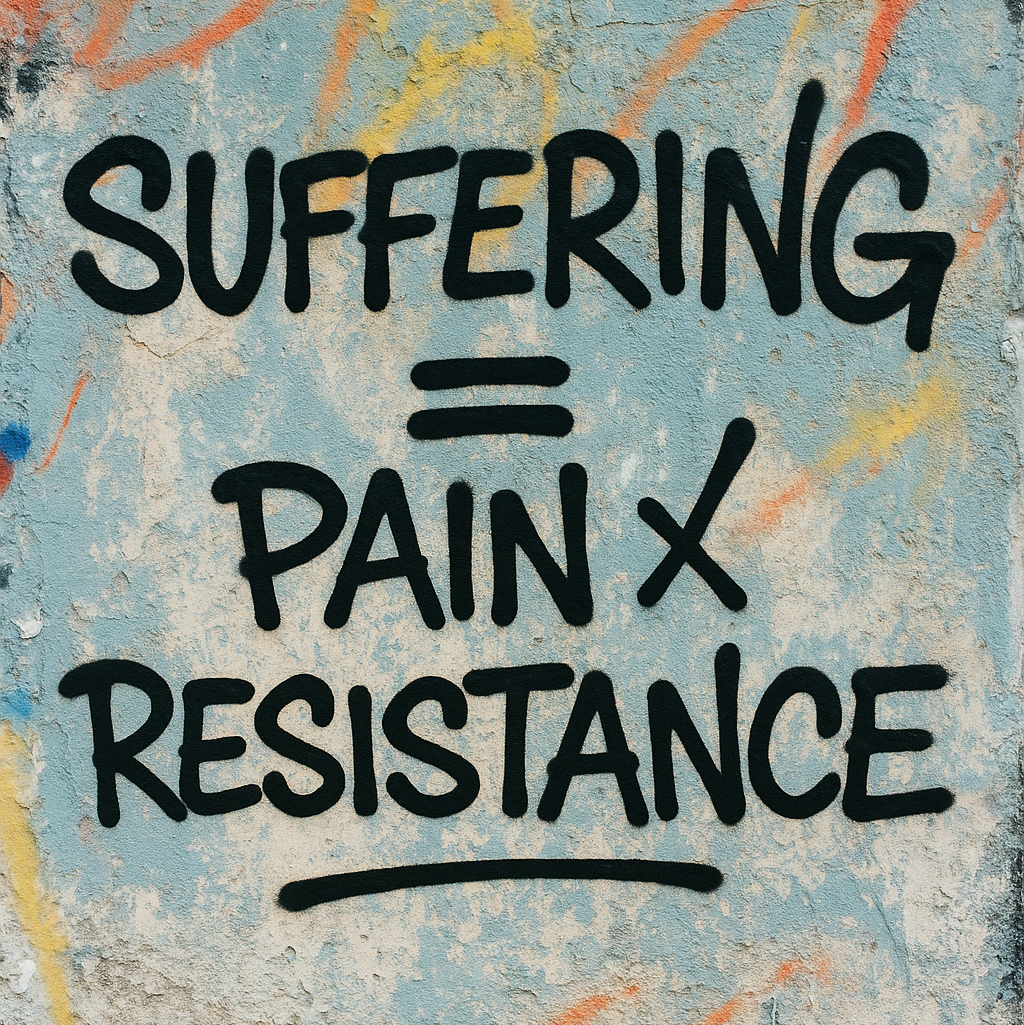
When we meet our pain with resistance, suffering multiplies. In Buddhism, this is known as the second arrow:
“When an ordinary person experiences a painful feeling, they sorrow, grieve, and lament. They feel two pains: the physical and the mental. It’s like being hit with a second arrow.”
The first arrow is the unavoidable pain of life — loss, fear, discomfort. But the second arrow is the one we fire ourselves — the stories, judgments, and reactivity we add to that pain.
When we untether ourselves from the narrative behind our pain and meet it with compassion, we disrupt the downward spiral. We stop firing that second arrow. We open a space for something else — presence.
In other words, by becoming mindful of the second arrow — our reactions, interpretations, and resistance — we can pause, find our center, and choose how to meet the moment.
This is true for complex emotions like grief or fear — but it also applies to pleasant ones.
We don’t just resist what hurts. We also resist what feels good… by clinging to it.
We often think of the second arrow only in terms of pain — but craving is its cousin. And craving arises when we want to hold on to something pleasant, grasping it, fearing its loss.
Both pain and pleasure are forms of attachment — one to what we don’t want, the other to what we don’t want to lose.
Oftentimes, we resist joy by trying to stretch it beyond its natural rhythm. Have you ever felt the tension of a beautiful moment slipping away, and in trying to hold on, you actually distanced yourself from it?
“When we attempt to hold on to a pleasant experience, we seem to enjoy the moment less.”
One night having dinner with a group of friends where I felt completely at home. We were sharing stories about our hometowns, laughing over fond memories and sentimental details. Something about that moment felt sacred — like I had stumbled into a pocket of time where everything was right.
And I didn’t want it to end.
So I lingered. I kept drinking, almost like I was trying to bottle the moment, to freeze it in place… and that did not go well 🤢
That’s a second arrow, too, and it creates suffering all the same. Whether the sensation is painful or pleasant, our attachment is what binds us — aversion to pain and grasping at pleasure.
Mindfulness brings us back to what is.
The breath.
The feeling.
The now moment.
When we release the demand for life to be different — to feel better, last longer, or stay still — we return to something more honest: our capacity to stay open. Whether the moment is painful or sweet, fleeting or frustrating, our presence becomes the anchor.
The way through is not force — it’s allowing.
And when we allow, we stop resisting ourselves. We stop judging what’s natural. We begin to meet life — and ourselves — with greater clarity, softness, and power.
We remember that we are not our emotions.
We are not our resistance either.
We are the awareness that can hold it all.
Final Thoughts
Suffering arises when we fight what is. Whether the moment brings pain or pleasure, clinging to control intensifies our discomfort. But when we meet life with acceptance — not agreement, but presence — we soften the edges of experience. We remember we don’t have to resist every ache or hoard every joy. We can breathe into both, knowing they will come and go.
Want to keep exploring?
Watch the full episode:
If you’re new here, welcome! This is part of the Emotional Wellbeing Series, where we learn how to build a relationship to ourselves to live more consciously. So far, we’ve been exploring the foundations of emotional intelligence — and now, we’re diving into the next layer of self-awareness, mindfulness.
👉 Whenever you are ready, you can start from the beginning here.
Where might resistance be turning discomfort into deeper suffering? What stories are you carrying about pain — and are they still true?