
How to Heal a Dysfunctional Ego
Why we feel lost, triggered, and unfulfilled — and how to reclaim the Self beneath the masks
Have you ever blamed a moment for being disappointing — and then realized it wasn’t about the moment at all?
After I unraveled everything I thought I was — the job, the identity, the plan — I expected to feel free. But instead, I found myself quietly irritated by… almost everything, really.
I remember my first family cookout in my new life. Everyone was kind and welcoming, and I was genuinely excited to taste the food — craving something simple, and familiar. But when I took that first bite, the flavors were buried under layers of sweet BBQ sauce. It caught me off guard. This wasn’t what I remembered food tasting like. And it wasn’t just the food — it was the beginning of a slow, creeping dissonance I couldn’t name.
There I was, plate in hand, thinking, “Why does everything feel so off?”
In a country where the language, customs, humor, and warmth all ran on different frequencies, my ego had nowhere to root itself. I wasn’t the funny one anymore — the jokes didn’t land. I wasn’t from here. And the politeness felt more alienative than connective. I didn’t even know the basic questions I could’ve been asking, like “Hey, may I skip the sauce?”
My sense of self — the one I had crafted up until then — had nothing to grip onto. And in that grasping, something deeper began to reveal itself.

This is what happens when the ego loses its anchors…
It scrambles for control.
Not in the dramatic, power-hungry way we often associate with the ego — but in quiet, subtle ways. It clings to what’s familiar. It assigns blame to the outer world for our inner dissonance. It looks for something — anything — to reaffirm a stable sense of identity.
For me, that looked like frustration over sauces and small talk, a low hum of judgment beneath every interaction. I wasn’t really upset about condiments. I was grieving the version of me that no longer fit — and the world that no longer mirrored her back.
That’s what the dysfunctional ego does: it confuses safety with sameness. It resists change because it was programmed to. In a new world, with no familiar cues, no feedback loops to confirm who we are… the ego can’t operate as usual. So it tightens its grip, tells repeating stories, projecting the discomfort outwards — all to avoid the deeper vulnerabilities it is protecting underneath:
I don’t know who I am here.
I don’t know how to fit in.
I don’t know if this version of me is enough.
Think of the ego as a feedback machine designed to help us navigate separation — to hold form, make decisions, manage risk, and give shape to our experience. Its primary directive is to ensure your survival — no matter what — based off of what you believe you need in order to fit in.
These beliefs are often rooted in childhood environments where being ourselves was unsafe or conditional, and disconnection from our internal world (feelings, desires, needs) is how we manage to get through it.
The key word here is beliefs. If you lack a sense of self — your values, preferences, boundaries, or identity feels unclear, unstable, or overly shaped by others, as it’s often the case in childhood — the ego will become dysfunctional not because it exists, but because we’ll identify with its masks entirely.
In order words, if the ego can’t attach its sense of safety within, it will attach without.

“When you measure your sense of worth by how you look, what you achieve, what you wear and possess, you are unconsciously choosing to let the world dictate your identity, hence, your personality. Even an inflated ego stems from overcompensation for a diminished sense of self, desperately needing to be actualized.”
Through mindfulness, we begin to see the ego for what it is: a tool, not our truth. We can witness our thoughts, our triggers, and our emotional reactions without immediately activating our protective and defensive parts. And in doing so, we create enough distance between our (observer) selves and our patterns. Enough space for the ego to soften, to loosen its grip. And for us to start asking different questions:
What part of me is being protected right now?
What story am I believing about this moment?
What’s the unmet need underneath this reaction?

How to Reparent the Ego (Without Waging War on It)
The ego doesn’t need to be destroyed — it needs to be seen, supported, and taught how to listen to a deeper inner authority. Here are five mindful ways to re-train your ego into alignment with your conscious self:
1. Celebrate Small Achievements
“The ego thrives on self-feedback and validation to achieve a perfect balance between self-care and caring for others.”
The ego is a feedback system designed to ensure our survival, and it adapts to whatever signals we give it. Its original job was to keep us safe within the tribe or family — to notice cues of belonging and danger so we could adapt and stay protected. It still functions that way today, but when we don’t update its mental loops, it treats every discomfort like a survival threat.
When we feed it criticism or comparison, the ego it becomes reactive and goes into defense mode — trying to fit in, to fix, prove, or control. But when external feedback is replaced with internal input — consistently celebrating small wins, finishing a task, honoring a boundary, or simply getting out of bed on hard days — the ego begins to recalibrate. Over time, it starts referencing our inner signals instead of searching for external approval, as it once did in childhood. The goal isn’t to get rid of the ego, but to reprogram how it responds.
2. Be Vulnerable
“Your ego is the result of everything your subconscious has stored… it will search for moments of compassion and magnify them.”
Control is the ego’s go-to strategy to avoid the discomfort of uncertainty and shame. But vulnerability is what opens us to truth, intimacy, and real connection. When we choose to soften — to name how we feel, to risk not having it all together — we signal to the ego that it's safe to evolve beyond its old protective patterns.
3. Acknowledge Your Shadows
“Anything not brought into the light of your conscious awareness will control your life from the shadows.”
The parts of ourselves we suppress or judge don’t disappear — they just operate from the unconscious, subtly shaping our behaviors, reactions, and self-concept. By acknowledging your shadow aspects — envy, shame, judgment, insecurity — without identifying with them, you teach the ego it doesn’t need to hide or defend. Awareness makes space for alchemy.

4. Let Go of Resentment
“You have to experience it all so you can move on to the next level of this game you are playing with yourself.”
The ego clings to resentment as a false form of power. But resentment is just unprocessed pain — energy that stays stuck when we try to rationalize or repress it. Letting go doesn’t mean pretending it didn’t hurt. It means feeling the energy fully and allowing it to move through, without attaching your sense of self to a story. This frees the ego from looping in survival mode.
5. Cultivate a Sense of Wonder
“If there is meaning in every interaction, allow yourself to wonder: What is this experience revealing to me about myself?”
Wonder interrupts the ego’s rigid narratives. It invites openness, curiosity, and possibility. When you ask “I wonder what this feeling is showing me…” or “I wonder what peace feels like today…” — you create space for the ego to participate in growth without needing certainty.
Wonder is how we reintroduce play into the process of becoming.
You can invite your ego to evolve — not through force, but through feedback, compassion, and conscious presence. When it learns to take its cues from your inner truth, it becomes an ally, not an obstacle.
Ego-Driven vs. Mindful Living
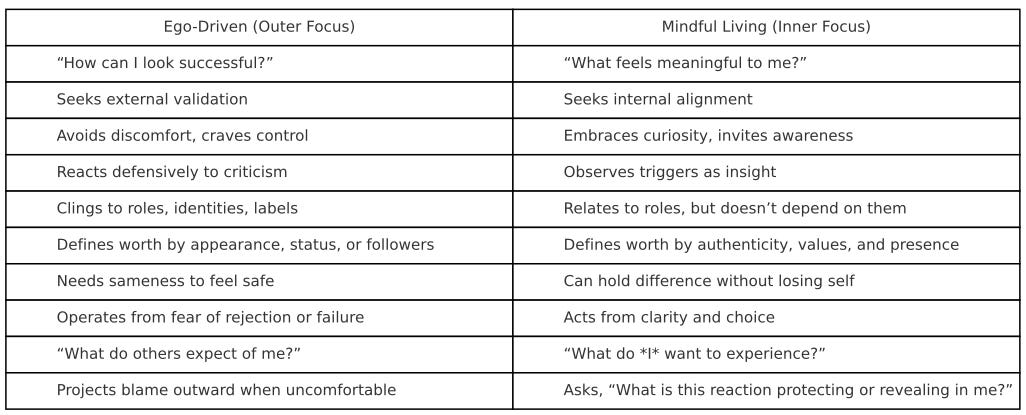
Mindfulness teaches us that the ego doesn’t need to be fixed or exiled — but transformed through our relationship to it. When we lead from within, we give the ego a new purpose: to serve our awareness, not substitute it.
Want to keep exploring?
Watch the full episode:
If you’re new here, welcome! This is part of the Emotional Wellbeing Series, where we learn how to build a relationship to ourselves to live more consciously. So far, we’ve been exploring the foundations of emotional intelligence — and now, we’re diving into the next layer of self-awareness, mindfulness.
👉 Whenever you are ready, you can start from the beginning here.
Which of the five ego-retraining practices — (celebration, vulnerability, shadow work, forgiveness, wonder) — feels most uncomfortable for you right now? And what might that discomfort be protecting?”