
How to Process Emotions: Practical Exercises to Understand and Release What You Feel
Master emotional self-awareness through body-based mindfulness and reflective tools for emotional healing.
In the guide to the beginner’s mind, you learned to observe your outer environment and begin noticing your inner states.
Now we take that one step deeper — learning how to actually feel your feelings in your body while inviting your mind to take a seat at the table..
With this tool, you will reflect on your current the levels of energy and comfort. Using this information, you can then scan the chart provided to discover what word best describes your actual state, and use the prompts to reflect on how you want to meet the moment.
The goal here isn’t to analyze or fix what you’re feeling. Just to get curious. Feelings live in the body, but we don’t always notice them behind the noise of our thoughts. This exercise helps you connect both, so you can understand what your emotions are really giving you data on about the beliefs you are carrying.

Step 1 — Set the Stage
Especially at first, give yourself a quiet space where you won’t be disturbed. This may feel easier to do when you’re alone, but over time, you’ll develop the skill to use this anywhere, even in real-time when emotions arise.
Also, as you go through this exercise, remember that a critical part of processing the feelings that shore up is to allow yourself to experience them in your body. If you find you need to cry, laugh, or be angry, then let those emotions be present.
Step 2 — Tune In to Your Body
Sit comfortably, close your eyes if it feels safe, and take a few slow breaths.
Do a quick body scan: where do you feel any sensations? Notice any tension, tightness, tingling, heat, heaviness, or even calm.
Stay with those sensations for a moment. Don’t try to explain or change anything. Just observe.
Step 3 — Rate Your Current State
To help you locate your emotional experience, assess two things:
1️⃣ Comfort Level
On a scale of 1 to 10, how comfortable is this feeling?
(1 = very uncomfortable, 10 = very comfortable)
2️⃣ Energy Level
On a scale of 1 to 10, how much energy do you feel right now?
(1 = very low energy, 10 = very high energy)
Step 4 — Name the Emotion
Using the numbers from Step 3, locate your feeling on the Feeling Meter to help you connect words to what you're experiencing.
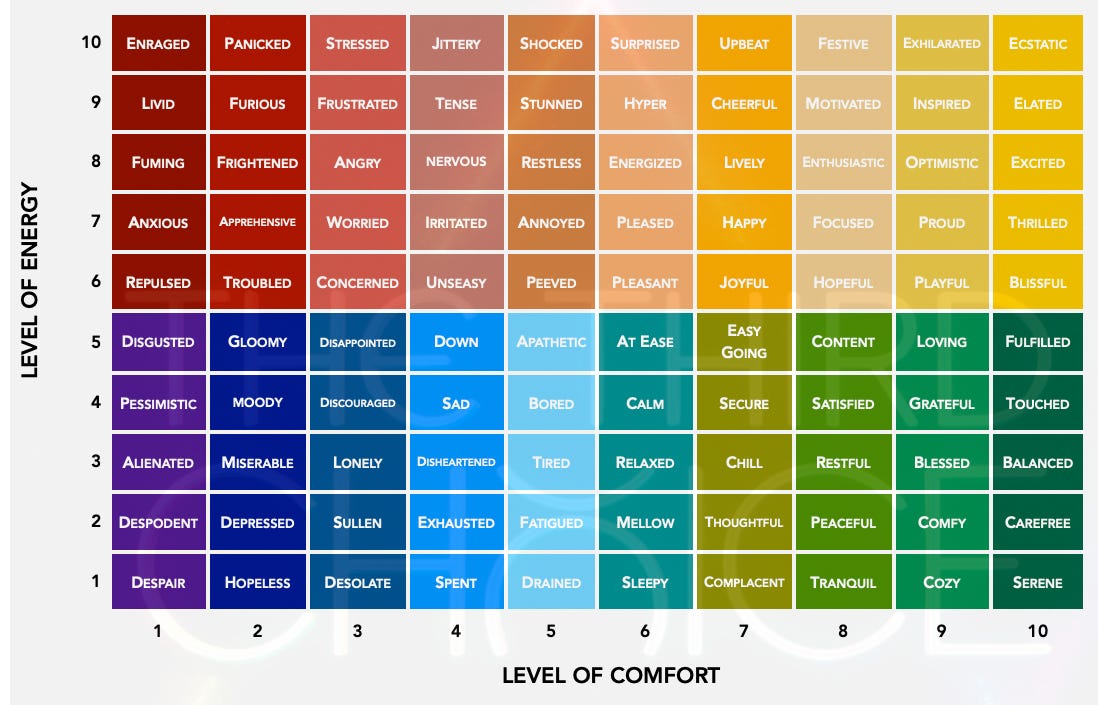
For example, if:
Level of Comfort = 3
Level of Energy = 8
→ This might suggest you’re feeling angry or frustrated.
Step 5 — Describe What You’re Feeling in Your Body
Write down what you notice physically:
“I feel heat in my chest and face, tightness in my stomach, and a buzzing energy in my arms.”
The more specific you are, the better you’ll get at tuning into your body’s signals.
Step 6 — Identify Your Thoughts
Now ask yourself: What story is my mind telling me about this feeling?
Write it down every thought that comes up without judgment:
“I don’t like when people criticize me. It makes me feel small and unseen. This is stupid. I don’t matter.”
Step 7 — Get Curious About the Story
Where might this thought have come from?
Did you learn it from someone?
Is it a belief you’ve carried for a long time?
Does a memory or past experience come to mind?
For example:
“I don’t like to speak in public. I remember my father criticizing my ideas when I was a child. Speaking up always felt risky.”
This reflection builds your personal “Feeling’s Dictionary” — a list of emotional patterns connected to your beliefs and past experiences. Over time, this will become your map to recognize recurring triggers and themes.
Step 8 — Keep Practicing
Feeling your feelings is a skill you strengthen with repetition. At first, it may feel uncomfortable or even confusing. That’s normal.
👉 The more often you pause, tune in, name the emotion, notice it your body, and explore your thoughts with curiosity, the easier it will become to process emotions as they arise — and release them fully.
Bonus Practice: Take it into your daily life
As you get more comfortable with this process, practice during daily activities you usually do on autopilot:
Eating
Walking
Washing dishes
Driving
Having small talk
Notice how your body feels while you're engaged. If your mind wanders or you start to overthink, gently bring your attention back to your sensations.
Be Patient With Yourself
This is not about getting it right. It’s about showing up for yourself with presence. You don’t need to have perfect words to describe what you’re feeling. Some days you might want to draw what you feel instead. Others days you’ll simply sit and breathe.
The most important thing is that you practice.

Getting to know ourselves fully takes patience and practice. Be kind to yourself and keep going!